It might shock you, but I have been foolish enough to carry a big little secret (or two) in my life.
- There was the time that I accidentally vacuumed up part of a deceased persons ashes and then proceeded to do my best to cover it up.
- Then there was the time I stole a friends watch and pretended that someone gave me one just like it.
- Then there was the time that I hurt someone dear to me through a dishonest and deceitful act.
- Then there was the time I had lied to others around me regarding a significant personal character issue.
All. Embarrassingly. True.
It would be easy for me to write this post and focus on all the public figures that have been caught out living a lie in recent times. Who would blame me? Celebrities are often very easy prey. Their lives are out there for the world to see feeding our insatiable appetite for peering into the private lives of others, and indeed we feast when they appear to be failing.
This need to see others at their most broken has always intrigued me. I mean, if I want to look deep into a life that has a history of wrong doing, deception, and foolishness I need look no further than my own life. I suspect many of us could say the same. Why look to others? The answer to this is rather simple,
focussing on the foolishness of others takes the focus away from my own failings and insecurities, and for that moment I am deceived into thinking that I am somehow better, especially better than the likes of (insert latest celebrity failure here…).

It is amazing though how secrets seem to make a way out, even after a VERY long time in hiding. And the ramifications are usually dire. It would seem the longer one prolongs the inevitable uncovering of the truth, the greater the impact and long term effect. Little secrets have big consequences. One thing we can be sure of however, is that everyone has a secret. Whether it is a secret the size of a giant squid lurking beneath the surface of our lie ladened ocean with consequences stretching like tentacles into multiple areas of our life, OR, whether a simple personal and private faux-pa, it is fair to say that most people have a skeleton or two in the closet.
‘Big deal’ you might say…
‘So people have a few skeletons in the closet, what business is it of mine? If someone is stupid enough to take performance enhancing drugs, lie about it, and then get caught, they deserve everything that’s coming… why waste time on this? why does this matter?’
If only it were that simple. Whether we like it or not our actions have far reaching consequences – good or bad. They have a direct effect on ourselves, on those closest to us, on that which we represent, and also on the culture we form.
1. Every culture is formed by the collective stories of the people that make up that culture.
Think about it… when your life and experiences combine with the lives and experiences of others, a bigger experience (or story) is formed. Whilst it is possible to live a totally isolated and disconnected life, when we do participate in life with others we develop common threads and common points of connection. For example, in the early days of Australian settlement convicts would support each other as they faced mistreatment and discipline by the authorities. the Aussie spirit of supporting the underdog began and today we still take great pride in supporting the ‘Aussie-battler’, those who are fighting against the odds. How we understand and experience each other (and ultimately ourselves) completely informs the culture we develop. So it stands to reason that;
When the stories of the individuals don’t represent the truth of their existence, our collective story becomes distorted. This means that (culturally speaking) we become influenced by things that just aren’t real.The result of this is that cultures develop patterns of operating, systems, expectations, and social norms that inevitably encourage others to become distorted images of their true selves as well.
Think about the effects of this on our families, our society, our organisations, our businesses, our churches and our communities. In the case of Lance Armstrong people the world over celebrated a man who had ‘achieved the impossible’, who had overcome great odds and who then earned millions of dollars telling that story. And many aspired to do the same. Of course this actually was impossible – even for the one who had supposedly done these things!
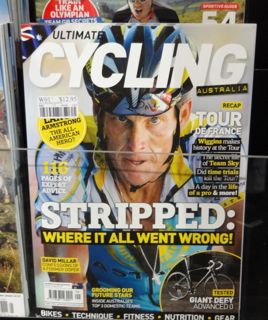
2. It’s never just the wrong-doer that is affected by their poor behaviour, the action becomes another reason to not trust what it is they represent.
Many have said they can never trust another champion cyclist – in their mind the sport of cycling has been forever tarnished as a result of Armstrong’s dishonesty. The same can be said for anyone that has knowingly misrepresented themselves.
- For the politicians who do a backflip on policy promises – yet again it proves that politicians and political systems can’t be trusted…
- the minister that is stood down for moral failings – another reason for people to never trust the church…
- the CEO that didn’t pay their taxes – another name on the list of greedy business owners…
- the wife that cheats on her husband – further proof that the institution of marriage is doomed. You get my point.
On the other hand, people and cultures that practice honesty and truthfulness, are freed of the shame of their failings and can cultivate a future based on possibility. Their personal (and collective) story is usually one of humility, openness, grace, acceptance and healing. Such cultures have a more accepting view of people and society, and therefore they’re better equipped and better placed to develop forward (rather than simply trying to maintain that which is not real). Consider for a moment the incredible healing that has begun for Australia as a nation and our indigenous people after the Prime Ministers ‘sorry speech’. On this particular issue there is a long way to go, but that moment which acknowledged all that was wrong, covered up, and misrepresented marked the beginning of restoration for many individuals (some would say a whole country) affected through the events of the stolen generation.
3. It may be cliche but I still believe that ‘honesty is the best policy’
Admitting we have done the wrong thing and then living as though we mean it is not only better for individuals, it is better for relationships, families, communities, cultures and humanity at large! In old school terms we call it confession and repentance – not simply a discipline for the Christian, it is just good plain and simple common sense. There is healing in the sharing of secrets. That shame, that embarrassment, that pain… it can be dealt with – I’m living proof of that. The writer of James put it this way…
I happen to believe that God wants us to be free of our secrets, what ever it is. This is not a free pass form the consequences of our actions, but it is a promise of freedom from a God that is first and foremost about grace. There is healing in sharing our secrets. So… before we jump to pointing the finger at the likes of Lance Armstrong, Peter Slipper, Arnold Schwarzenegger or whoever else you might like to add, we would do well to pause and remember the time we made a mess of things. It is for times such as these that these words were penned…
So… What’s your big little secret? Might I suggest that now is the time to fess up and begin the work of healing? If you’re brave enough, start right now. Tell someone. If you’re really brave, you can tell us right here, right now and comment below.
BK


 BK's blog...